Daily Inspection has two purposes: to produce a consistent visual record and to document Micheal’s adherence to an agreed presentation protocol.
Within this project, presenting for inspection is a practical expression of submission. The attire, positions, and sequence are specified in advance rather than chosen anew for each recording. Micheal’s role is to follow that protocol and submit the evidence for review. The Accountability Partner assesses whether the published standard has been met.
The inspection evaluates compliance with the recording requirements — not Micheal’s worth, attractiveness, or entitlement to respect.
The camera remains fixed. The participant changes position. Wait opens and closes the recording; the four inspection views produce the daily photographic record.
The positions
no photograph is filed from it
Every session opens and closes here. At the opening it is held while the day, date, recorded weight, and verification information are established on the record; after the four views are complete the participant returns to it while the session is closed. It files no progress photograph — it gives every recording a defined beginning and end, and a stationary identifiable frame before and after the sequence.
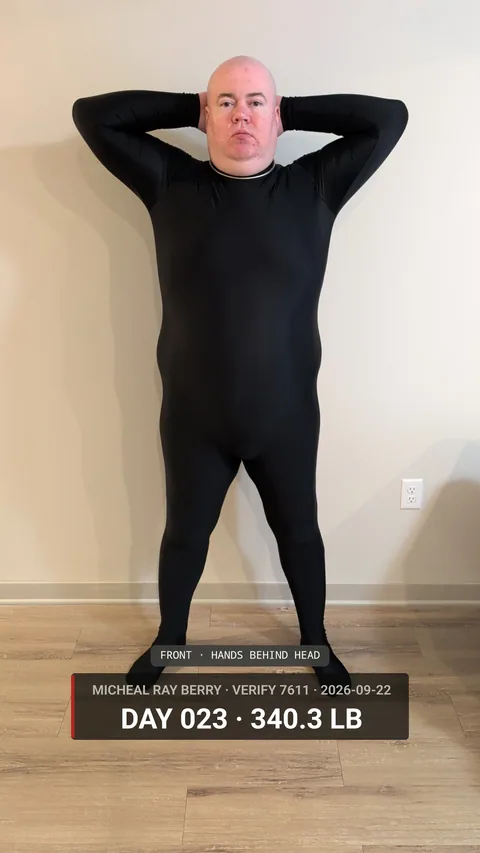
The primary front reference frame. Hands behind the head keep the torso unobstructed and prevent the arms being used to materially alter the silhouette.
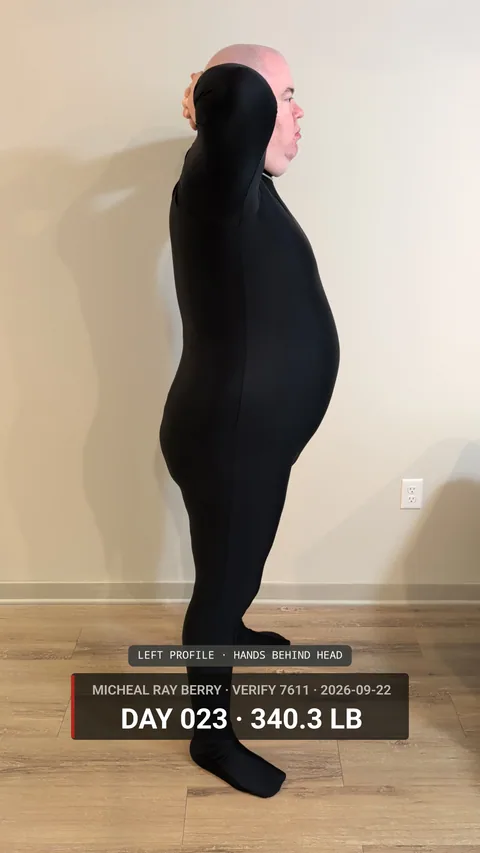
The camera does not move. The side profile records changes in body depth and shape that cannot be evaluated as clearly from the front view alone.
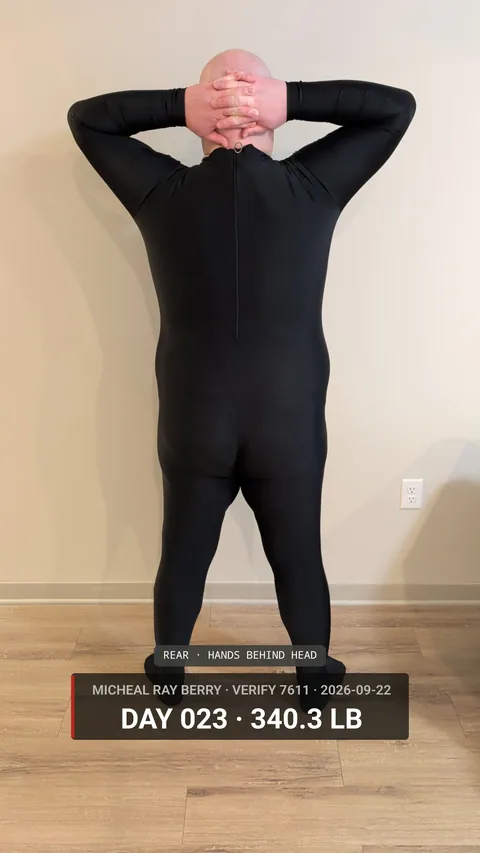
The complete body remains visible from head to feet.
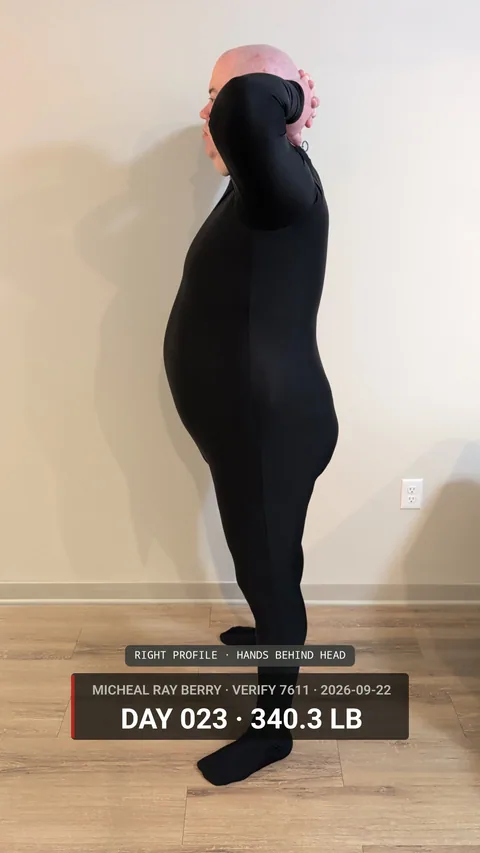
Both profiles are required. Recording each side makes differences in stance or body shape visible rather than allowing one preferred profile to substitute for the other.
Reference frames from Day 23, September 22, 2026 — the most recent complete record. View that day.
Specification
Upright, weight distributed evenly, feet at the established inspection width, hands behind the head. This keeps the torso visible, moves the arms away from the sides of the body, and reduces the ability to change the apparent silhouette through arm placement. The posture is held naturally and consistently: no deliberate flexing, compressing, twisting, or leaning for the photograph.
Separate from the four photographic positions. Feet together, hands behind the back, body upright and squared to the camera, head level, eyes forward. Performed at both the opening and closing of every inspection recording. No progress photograph is filed from Wait.
The head remains level. During the Front view and both Wait positions the face must be completely visible — identity must be apparent from the recorded image itself rather than from a filename, caption, or accompanying text. Hair, clothing, hands, or other objects may not materially obscure the face.
A consistent height and distance, portrait orientation, the complete body visible from head to feet. The camera remains stationary throughout: the participant turns, the camera does not. Zoom, height, framing, and distance stay substantially consistent from one daily record to the next.
The designated project uniform: a plain black full-body unitard and a plain steel or titanium collar, worn in every official recording. The unitard standardizes the visual record. The collar symbolizes Micheal’s chosen submission within the written agreement. See the uniform standard.
Four are produced from each compliant inspection — front, left, rear, and right. Wait is recorded on video but files no progress photograph. Each is taken from the required position rather than selected afterwards according to which image is most favourable.
The verification code is issued immediately before the recording and appears as part of the recorded evidence. The required positions are checked while they are presented. Once an Accountability Partner is engaged, the Partner reviews the submitted record for identity, attire, framing, required views, and completeness before accepting it as compliant.
What invalidates a view
A photograph or recorded view does not meet the standard when the comparison or the verification has been materially compromised. For example:
- Any required part of the body outside the frame
- Face obscured during a required identification view
- Incorrect position, or hands not in the required position
- Arms obstructing the torso during an inspection view
- Materially different camera height or distance
- Camera movement between required views
- Altered or noncompliant attire
- Leaning, twisting, flexing, compressing, or another posture that materially changes the silhouette
- Failure to present one of the four required views
- A verification failure that prevents the recording being tied to the day’s record
A view that fails the standard is recorded again rather than filed. Within an unbroken take, only the failed view is repeated: the assistant returns to that view and the sequence continues from there. If the take itself is broken — the recording stops, the camera moves, or the participant leaves the frame — the recording is void and the complete sequence is recorded again from the opening Wait. The objective is not to produce the most favourable photograph. It is to produce the required photograph.
Why it is specified
Longitudinal photography is useful only when the method that produced it stays reasonably constant. Progress photographs taken weeks or months apart typically differ in clothing, camera distance, pose, framing, and angle — so the difference between them is partly the body and partly the staging, with no way to tell how much of each.
This record takes the opposite approach: daily, in the same uniform, from a consistent camera position, using the same sequence and the same four views. Any two of its days can be placed side by side and compared on substantially the same terms. That is why a frame which fails the specification is recorded again rather than kept simply because a photograph was taken.
Inspection is not correction
These positions produce the daily documentation record. They are separate from the posture required during a corrective session, which is governed by its own standard and applies only after a documented violation. Inspection positions document the day; corrective positions address a documented failure.
Command vocabulary
Every session uses a controlled vocabulary. Routine commands are answered through the required movement rather than a spoken acknowledgment.
- Present [position] — assume the named position to the published standard.
- Hold — maintain the position until the next instruction or until the session is stopped.
- Correct your posture [specific defect] — correct the identified issue. Used only when a correction is required, and only when a person or the assistant's pose check has identified the defect; otherwise the narration uses a neutral reminder such as “Maintain the required hand position.”
- Release — the instructed session has ended. Acceptance of the submitted record remains subject to Accountability Partner review.
The vocabulary is standardized so each command has a defined, practiced response. Necessary clarification, discomfort, and requests to pause or stop may be voiced at any time.